Home Design Trends for 2027: Pairings, Costs and What to Skip
Named designers in Austin, Dallas and Houston on what comes next — travertine, warm stone, honey oak, living brass — each quoted, dated and linked to the source.

Every January a hundred articles tell you what's trending in kitchens. Most of them are describing something that'll look dated in four years, which is a problem in a room you plan to live with for fifteen years.
So this is a different list. These are combinations we're actually building, chosen because they age well.
Where this comes from
We build kitchens; we don't forecast them. So instead of inventing a trend list, we read what designers whose work we respect have actually published, and paired it with what clients are asking us to build right now.
One thing worth saying plainly before you read on. The proper 2027 forecasts from Architectural Digest, Elle Decor and House Beautiful have not published yet — that cycle runs October to December. Anything online today claiming to list 2027 trends was almost certainly written by a marketing team, not a designer. What follows is sourced from named people, with the month it appeared and a link, so you can go and check every one of them.
Austin
The gray era is over, and limestone is coming inside
An Austin designer writing about Austin houses. She says the cool gray palette that ran this city for a decade is "firmly behind us," and calls instead for clay and terracotta, honey and caramel wood tones over cool ash, Texas limestone used indoors as well as out, and quartzite and marble chosen for movement rather than consistency.
The most useful trend piece we have read for this market, because it is written about this market. Read it →
Dallas
Materials that are allowed to age
Dorsey is a Luxe Interiors + Design Gold List honoree and was named in D Magazine's 2026 Best Designers in Dallas. On where things are heading, he is unusually direct: "The era of plasticized 'perfect' finishes is over. Luxury is being redefined by material integrity — surfaces that have the capacity to age, wear, and tell a story. We will see a drenching of spaces in raw, honest materials: unsealed stone, hand-applied plasters, and 'living' metals."
Unsealed stone, hand-applied plaster, unlacquered brass. If you want one sentence for where the top of this market is going, that is the one. Source → · chaddorseydesign.com
Houston
Richness from clarity, not elaboration
On what has his attention now: "Sculptural lighting, natural finishes, and the idea of creating sanctuaries that feel calm, grounded, and richly human." And on how his own thinking changed: "Early on, I equated richness with elaboration. Today, richness comes from clarity."
That second line is worth more than most trend lists. Source → · benjaminjohnston.com
Wellness designed into the house, not bolted on
Magon, whose work has been covered by Forbes and WWD, is building an entire Houston residential project around this idea: "Wellness shouldn't be an occasional practice, it should be central to daily life." In a renovation that means the steam shower, the light, the air and the water get designed in at the start rather than added at the end.
The wider read
Statement stone, book-matched and carried up the wall
Both name heavily veined natural stone — viola marble, emerald quartzite — used large-format and book-matched as the defining countertop move, and Cohen notes it is now moving out of kitchens and into bathrooms. Published in Homes & Gardens.
In practice this means a slab yard visit, not a showroom sample. The veining across the piece is the design. Source →
Honey-toned oak, not white and not gray
Gianni calls for closed uppers in honey-toned rift white oak. Beachy describes light oak with Taj Mahal quartzite as the pairing that now needs more depth and contrast under it — useful, because it says where this is going rather than where it has been.
Rift-sawn white oak, ash, and a light stain over a warm undertone. Not the cold bleached oak of five years ago. Source →
Travertine and honed limestone
The one to watch. Travertine, honed limestone and other soft warm stones are appearing on floors, backsplashes and increasingly counters. They read far warmer than marble, cost less than premium quartzite, and unfilled travertine has a texture no engineered surface has copied convincingly.
Fair warning from the people who install it: travertine is porous and soft. On a kitchen counter it will mark. We would use it on a floor, a backsplash, a fireplace surround or a powder room before we would put it behind a range — and we would say the same to your designer.
Living finishes over polished brass
Wicksteed describes "soft kitchens" built on antique brass, warm timber, contrast oak and marble. Jung is blunter: polished brass is "starting to feel oversaturated," and she is steering clients toward burnished, antique and champagne finishes.
Unlacquered brass patinas. That is the point of it, and it is the thing to be certain about before it is installed, because it cannot be undone.
Patina over perfection
Berkus, who calls himself famously anti-trend, points to deeper earth-rooted colors with "hand-finished woods, plaster, stone with irregularity." Parker at deVOL calls for "dull, gentle beiges and creams, old wood and concrete." Different vocabularies, the same instinct — and the same one Dorsey names from Dallas.
Four designers in three states, independently describing the same shift. That is usually what a real trend looks like before anyone writes the listicle.
Every designer above is quoted from a published article or their own journal, with the month it appeared and a link to the source. If you are one of them and we have characterized your view wrongly, tell us and we will correct it the same week.
What we are being asked to build right now
Which brings us to the rooms themselves. Every photograph below is our own work, in Austin, this year.
1. Sage green cabinets · white quartz · brass · white oak floor

A muted green base with white uppers, quartz counters, unlacquered brass, and a warm white oak floor. Green reads as a color but behaves like a neutral, so it's held up while other cabinet colors have come and gone.
Unlacquered brass is the detail that decides this one. It darkens and marks as you use it, which some people love and some people hate. If you want it to stay bright and even, choose a lacquered finish instead and know that you're choosing it.
Ages well because nothing in it is a statement. It's a warm, quiet room.
2. White or off-white cabinets · honed stone · matte black
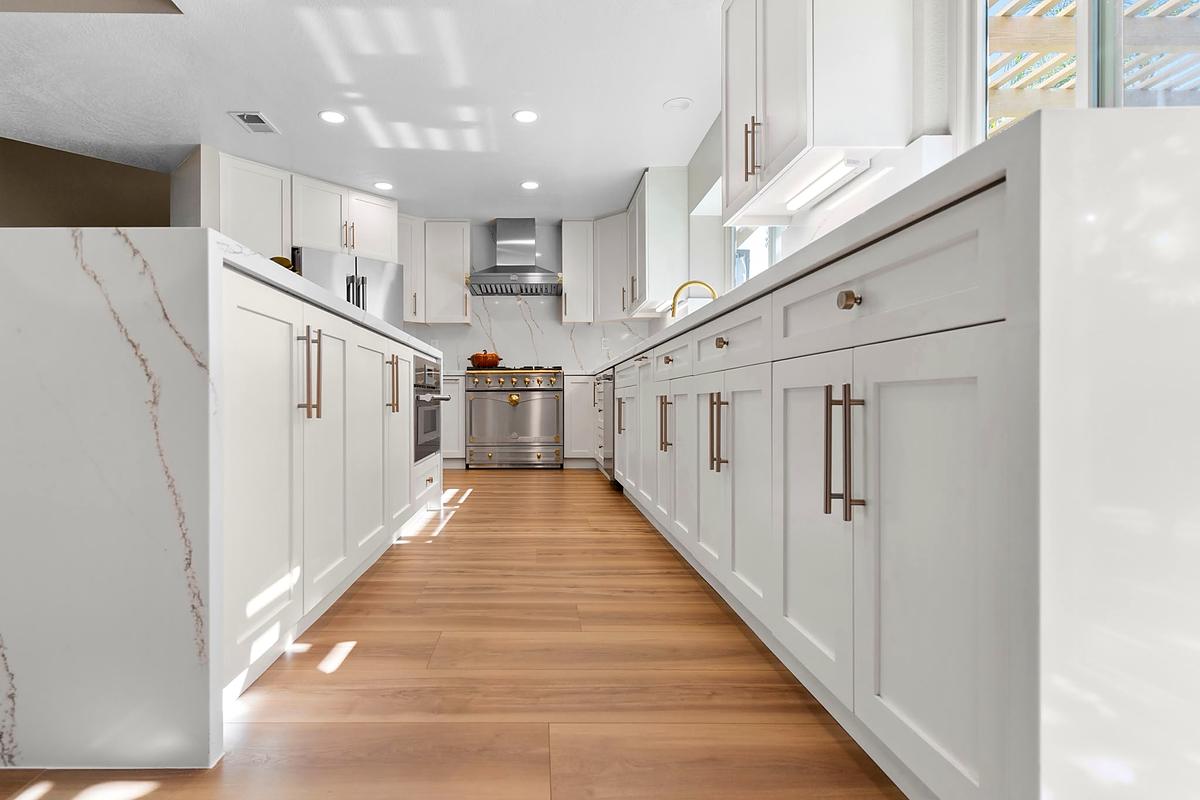
The safest combination on this list and, done properly, not boring. The variable is the stone — a honed surface with real movement gives a plain palette everything it needs.
Matte black hardware and taps keep it from reading as sterile. Skip polished chrome unless the rest of the house is doing something specific with it.
Ages well because it's been ageing well for thirty years.
3. Walnut or rift oak · white quartz · integrated appliances
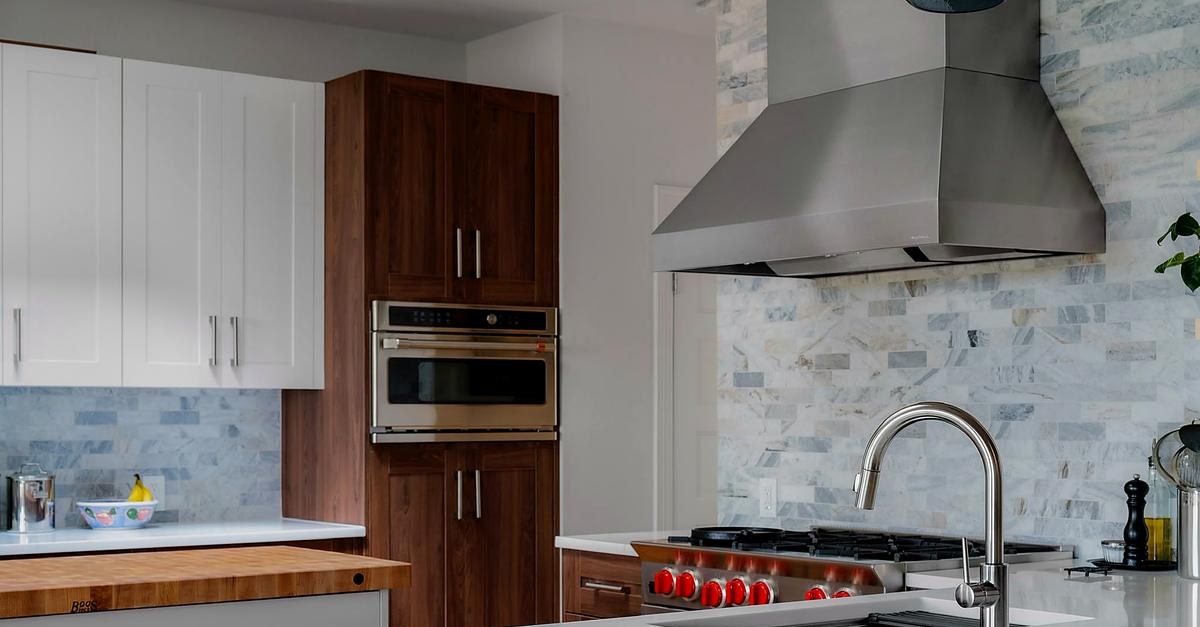
Real wood cabinetry rather than painted, with paneled appliances so the room reads as furniture. It's the most expensive combination here because the cabinetry has to be full custom — veneer grain has to run continuously across a run, and that's not something a catalogue does.
Ages well because wood ages well. Paint chips; wood develops.
4. Two-tone: dark island, light perimeter
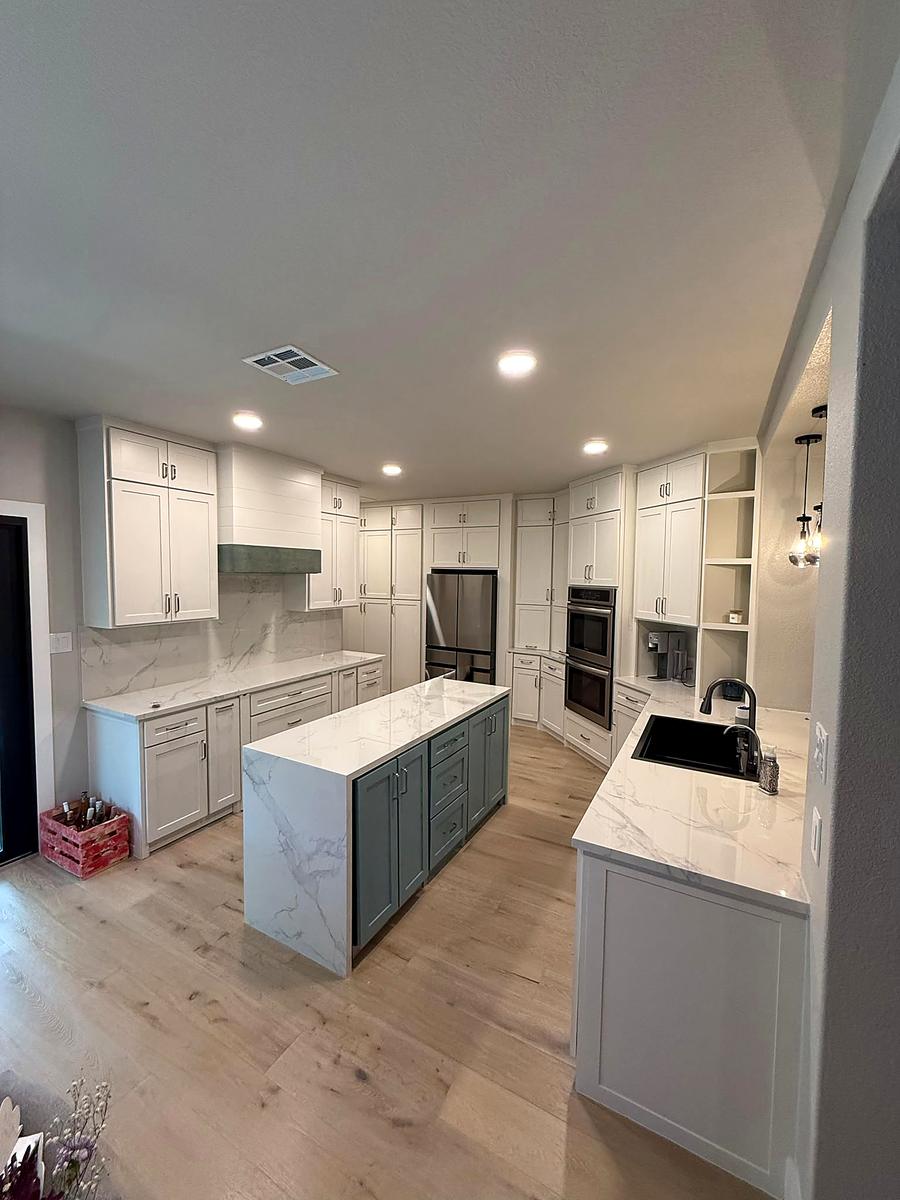
Light perimeter cabinets with a darker island in navy, charcoal, or deep green. It gives a large kitchen a center and makes a small kitchen feel taller.
One thing to get right: put a different counter material on the island — butcher block or a stone with more character. Two-tone with the same counter everywhere reads as indecision rather than design.
Ages well because the island is the cheapest thing to repaint if you tire of it.
5. Brick or stone backsplash · painted cabinets · butcher block island
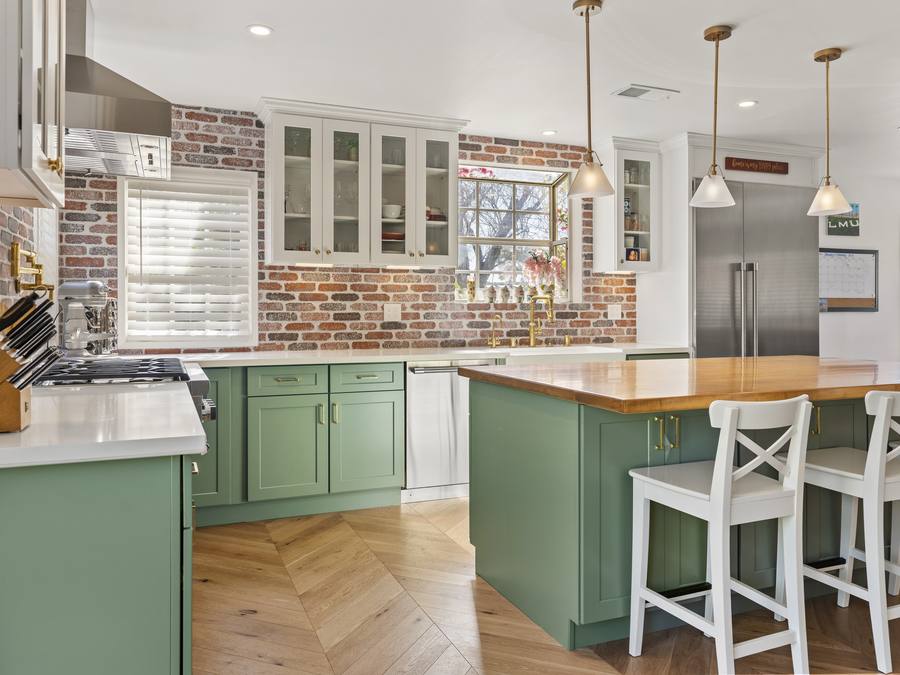
A masonry backsplash carried across the whole wall instead of a strip of tile, with painted cabinets and a wood island top. It gives a new kitchen texture and age, which is hard to buy any other way.
Two warnings. Brick needs sealing behind a range or it will hold grease forever. And butcher block is a maintenance choice — it needs oiling, it marks, and it's happier as an island top than as a work surface by a sink.
Ages well because it already looks like it's aged.
Where the money should go: stone and wood
If you only lift two things out of this list, lift these. Natural stone and properly stained hardwood are the two materials that separate a good kitchen from an expensive-looking one, and neither of them can be faked convincingly.
Natural stone over engineered, where you can afford it. Quartz is consistent, hard-wearing and perfectly good. But a book-matched slab of marble or quartzite carried up the wall behind the range is the single most striking thing you can put in a kitchen, and there is no engineered product that reads the same way in person. It marks and it patinas. That is the trade, and people who love it love it for exactly that reason.
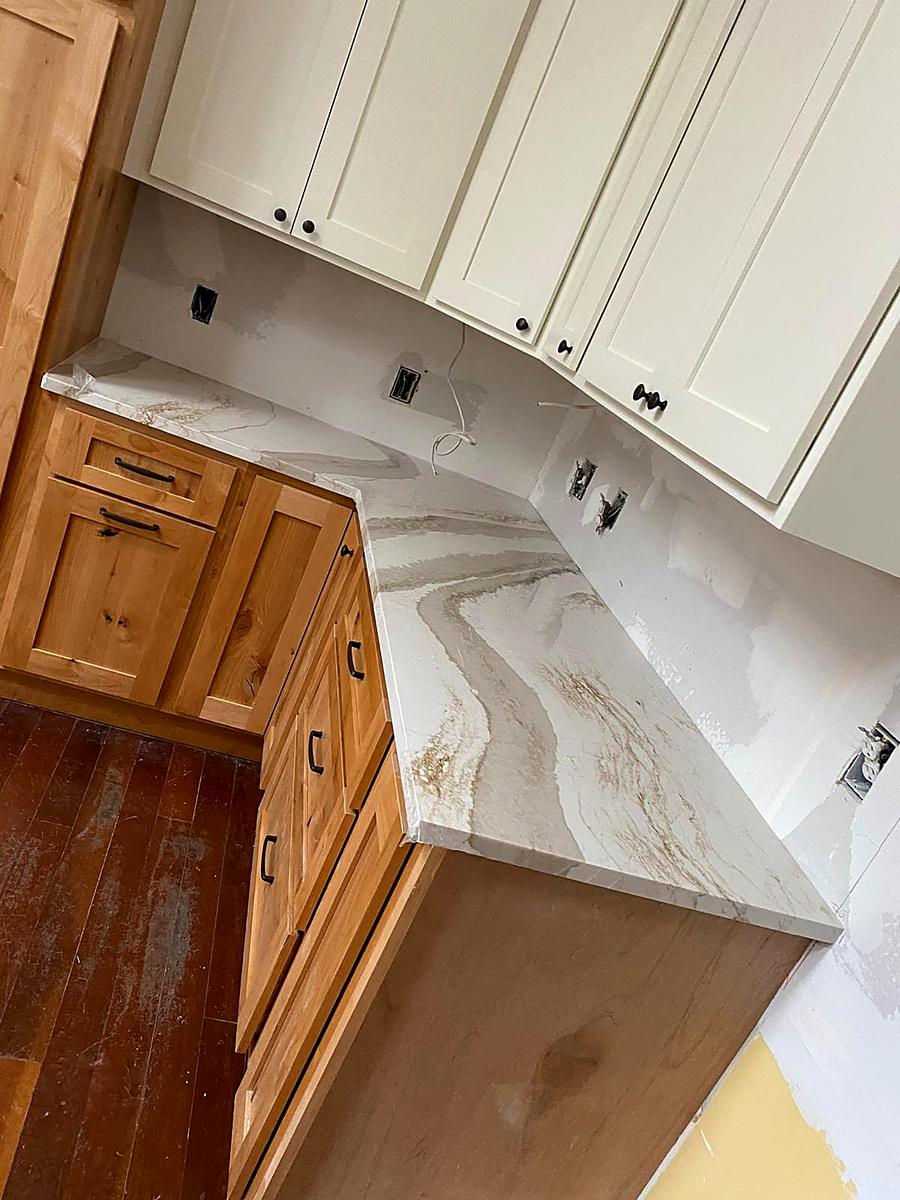
Stained hardwood over painted, on at least one run. Paint is a finish. Stain is the wood showing through, which means the grain, the species and the person who sprayed it all matter. Rift-sawn white oak, walnut and stained maple are what the high end of this market is doing, and a stained island against painted perimeter cabinetry is the cheapest way into it.

Every photograph on this page is our own work. If you want to see what the very top of this market looks like, the studios on our list of Austin interior designers publish their own portfolios — go and look at Amity Worrel, Allison Burke, Avery Cox and Cravotta directly. We would rather send you to their sites than reproduce their photographs here.
What we'd avoid
- A very specific color of the moment. If it's everywhere this year it will date this decade.
- High-gloss cabinet doors. Every fingerprint, forever.
- Heavily veined stone on every surface. Beautiful on one, exhausting on three.
- Open shelving instead of upper cabinets, unless you're genuinely tidy. Most people aren't, and they miss the storage within a year.
- Matching everything in the appliance package to one finish that the manufacturer may discontinue.
The rule underneath all of it
Pick one thing to be interesting and let everything else be quiet. A kitchen where the stone, the cabinets, the backsplash and the hardware are all making a statement doesn't read as luxurious. It reads as loud.
See what a kitchen costs.
Three tiers, published, with what pushes a project to the top of each one.
2027 trends, answered
Are 2027 trend forecasts published yet?
Not the flagship ones. That cycle runs October to December 2026. Architectural Digest, Elle Decor and House Beautiful have not published their 2027 forecasts at the time of writing. Anything online today claiming to list 2027 trends is almost certainly written by a marketing team rather than a designer.
Everything on this page is quoted from a named designer with the month it was published, and linked so you can check it.
Is travertine a good idea in a kitchen?
On a floor or a powder room, yes. Behind a range, we would talk you out of it. Travertine is porous and soft. It marks, and unfilled travertine holds what lands in it. That texture is exactly why people want it, and exactly why it is the wrong counter material next to cooking.
We would say the same to your designer.
Is white and gray really over?
The cool gray palette is, according to every designer quoted on this page. The direction named repeatedly is warmth — caramel and honey wood tones over cool ash, limestone and travertine, and stone chosen for movement rather than consistency.
White is not gone. Cold white with gray undertones is what is being replaced.
Will unlacquered brass age badly?
It will patina, and that is the point of it — but be certain before it is installed. Living finishes darken unevenly wherever hands touch them. People who love it love it for that. People who expected it to stay bright are unhappy within a year.
If you want the look without the change, ask for a lacquered or PVD finish instead.
Choosing materials for your kitchen?
Bring us the combination you like. We will price it on your room and tell you which parts of it are worth the money and which are not.
One office, one number. Every inquiry is read and answered personally, the same business day during work hours.
Two years on workmanship · lifetime warranty on our shower pans · fully insured · NARI member