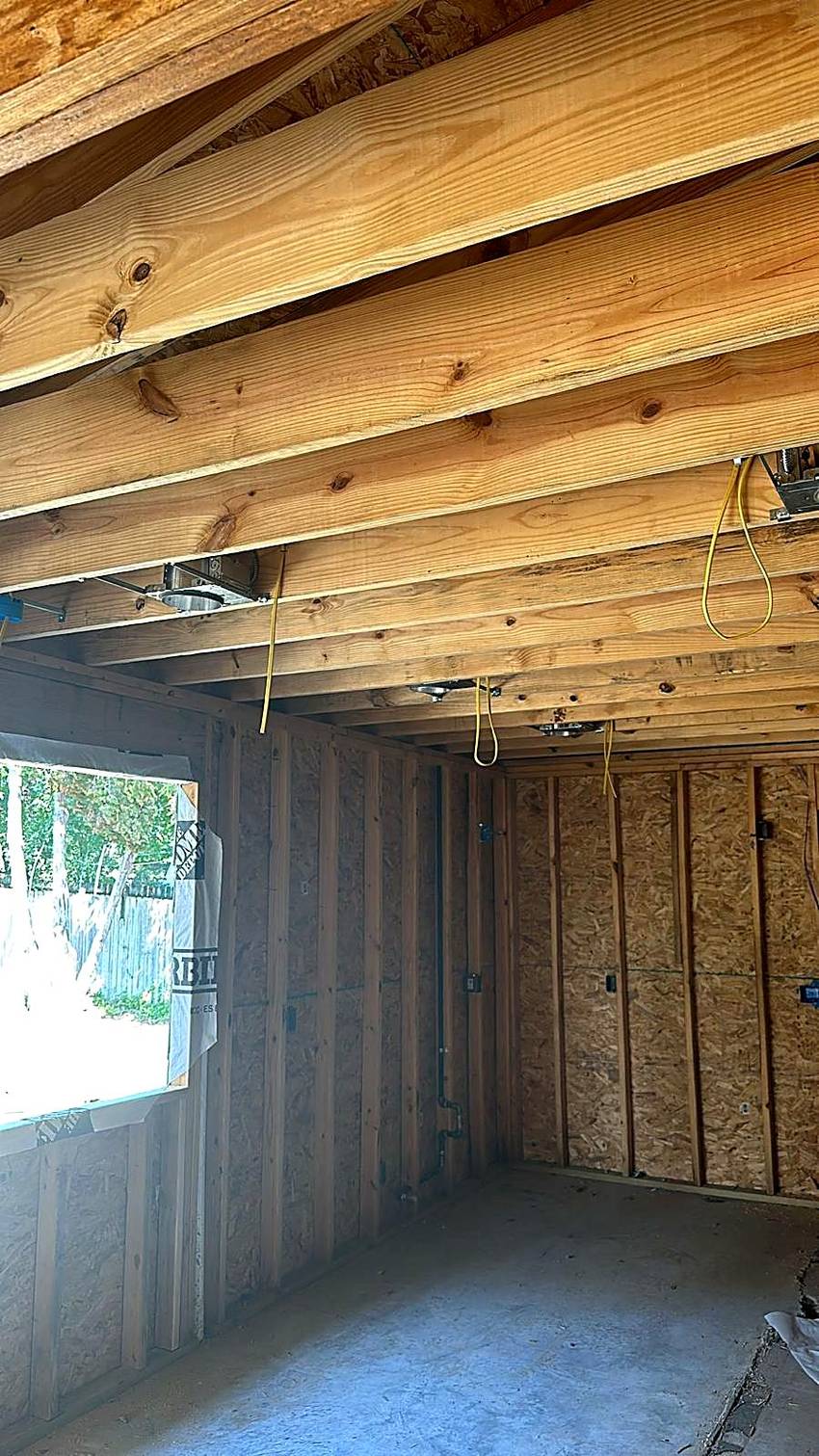
Whole-home renovations don't usually go wrong because of bad building. They go wrong because something was left unsettled at the start and got decided under pressure in month four.
1. Where you're living
Settle this first, because it changes everything else.
You can't live in a whole-home renovation. Every wall is open, the systems are off for stretches, and no room stays clean. We won't take the job on that basis and you shouldn't want us to.
So: are you renting for the duration, staying with family, or timing it between closing on the house and moving in? The third is by far the best if it's available. And run the numbers honestly — if moving out costs $12,000 in rent, and staying costs you a slower schedule and months of everyone being short with each other, it's closer than people assume.
2. The real budget, including the part you hold back
Not the number you could borrow. The number you're comfortable with.
And separately, hold ten to fifteen percent back on a house built before 1990. On a full gut we find something in nearly every project — that's what happens when you open every wall at once. Cast iron drains, undersized electrical, water damage nobody knew about.
A client stretched to the last dollar has no room when that call comes, and it's the worst position to make a decision from.
3. Every selection, before demolition
This is the one people underestimate most.
Cabinetry, appliances, tile, stone, plumbing fixtures, lighting, hardware, flooring, paint. All of it decided and ordered before the first wall comes down.
Late selections are the single biggest cause of overrun on a large project. Not bad weather, not trades, not permits — a client who hasn't picked the tile. Every day a decision sits open, a crew is either waiting or working out of sequence, and working out of sequence costs money twice.
A good contractor gives you a dated selections schedule at contract signing. Treat those dates like the deadlines they are.
4. Who decides
If two people own the house, one of them needs to be able to answer a question in an afternoon.
This sounds small and it isn't. Projects stall because a decision needs two people in a room and they're both busy. Agree in advance who signs off on what, and what the limit is above which you'll both discuss it.
If there's a designer, agree who owns which decisions too — and whether change orders route through them or straight to you.
5. What you actually want the house to be
Not the finishes. The life.
How many people live here in five years. Whether anyone works from home, and whether they need a door. Whether the family eats at a table or at an island. Whether parents will stay, and for how long. Whether you're keeping this house or selling it in six years.
Those answers change the plan more than any material choice, and they're the questions that almost never get asked in a first meeting. We ask them because they're the difference between a beautiful house and a house that works.
The short version
- Know where you're sleeping
- Know your number, and hold 10–15% back
- Choose everything before demolition
- Agree who decides
- Be clear about the life, not just the look
Settle those five and the rest is building — which is the part we're good at, and honestly the part that goes wrong least often.
Thinking about a whole-home renovation?
We'll walk the house with you at no charge, including before you buy it, and tell you what it needs and what it'll cost.
Whole-home planning, answered
How long does a whole-home remodel take?
Plan on several months on site, plus design, pricing and permits before it. The site time depends on whether systems are being replaced and whether the footprint changes. Design and pricing is one to four weeks, permits typically three to six.
The projects that run long are almost never the ones with hard construction. They are the ones where selections were still open when demolition started.
Where should we live during it?
Somewhere else, on a lease that runs longer than the schedule. A whole-home renovation takes plumbing, power and heating out of service in turn. Budget the housing cost as a project line, and give the lease a buffer — moving twice is worse than paying a month you did not use.
This is the single most common item people leave out of the budget.
When do selections have to be final?
Before demolition, not during it. Tile, cabinetry, plumbing fixtures, appliances and lighting all have lead times, and several of them determine rough-in dimensions. A fixture chosen late is a wall opened twice.
We give you a selections deadline schedule with the contract so you know which decision is due when.
Page specification
- URL
- /blog/before-a-whole-home-remodel/
- Title tag
- 5 Things to Settle Before a Whole-Home Remodel (46)
- Meta
- Five decisions to settle before a whole-home remodel starts — scope, budget hold-back, where you live, who draws it, and how change orders get priced. (150)
- Schema
- Article
- Conversion role
- Pre-frames the sales conversation entirely in your favor. A client who reads this arrives already agreeing with how you run projects.